Apps for Change: four flavours


After a busy few months at the Newsmast Foundation, here’s a building in public update.
Pilots full of flavour
At the end of last week we pushed our first creator app to stores, and released our first professional network app for testing. With all four flavours of community app and platform live or in test, it’s been a successful pilot phase for our Apps for Change programme. Here’s where we are at, across the flavours:
Journalism
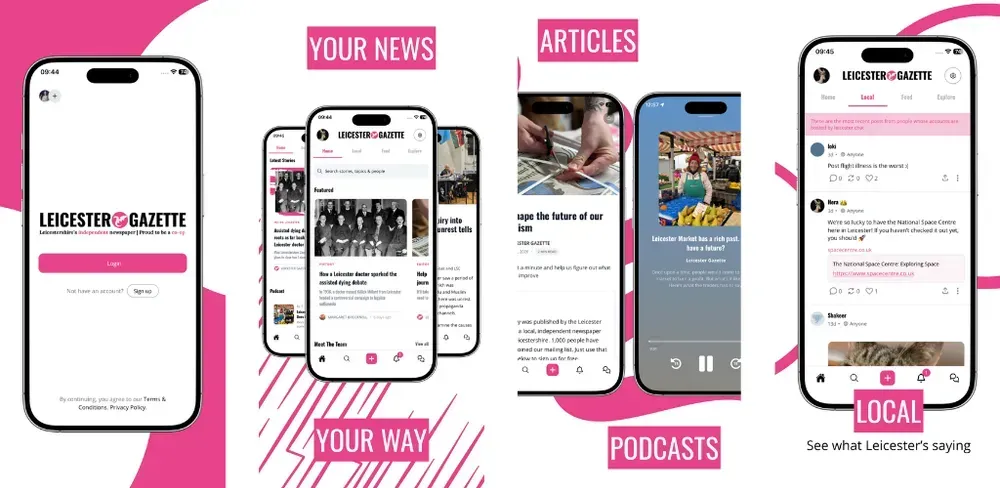
The Leicester Gazette app went live on 6th April, combining local news with a social web community. The news comes from Ghost, complementing the work we’ve done with Wordpress at The Bristol Cable. Rhys and the team at Leicester Gazette have been a pleasure to work with, fine-tuning the app to meet their needs, down to a flying wyvern on the search page.
This is a free app, open to anyone who wants to connect with the Gazette, their stories, and the local community. The launch was timed to coincide with the paper’s second print edition, and we’re delighted to feature in this.
Along with Jaz, our Commercial Advisor, I was at the Online News Association Conference in Chicago at the end of March, and from the contacts we made there we aim to launch some US pilots later this year.
Content creators
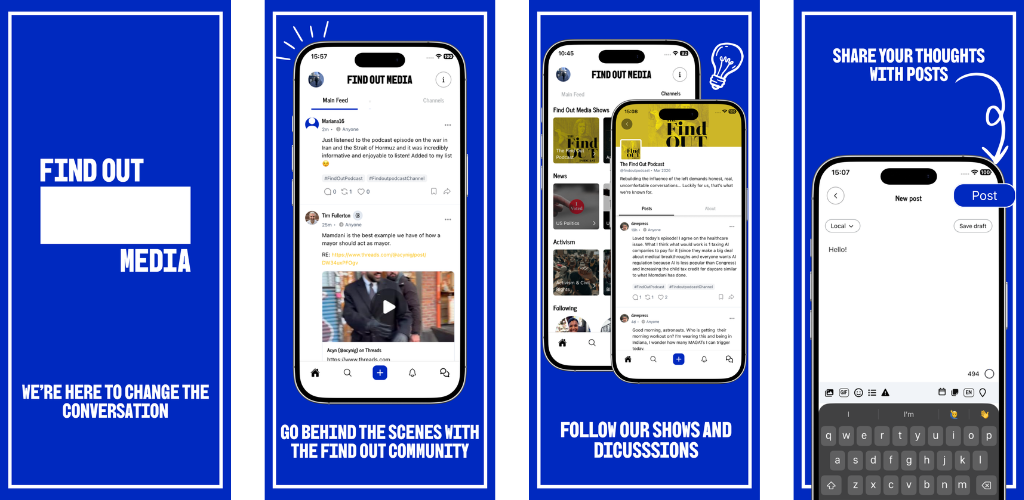
Our US partner, Find Out Media, goes from strength to strength, acting as an umbrella for a range of progressive podcasts, from the flagship Find Out Podcast, through Nora Haynes is not a Spy, and the inimitable Get Angry. If you’ve not seen ItsLuke on TikTok or Instagram, he's not one to hold back - and for the podcast he’s teamed up with Bryan Andrews for more of the same.
The Find Out app is now out with testers, and will be launching in the next month. The app features a lot of innovations:
- Video podcasts, embedded in Wordpress.
- Podcast reactions linked through to the Fediverse via the ActivityPub plugin.
- Local only posts.
- Show channels - open groups where podcast followers can chat about each show.
- Auto-Bluesky bridging - every account opened will automatically be bridged via BridgyFed.
We’re excited to see where this one goes.
Community
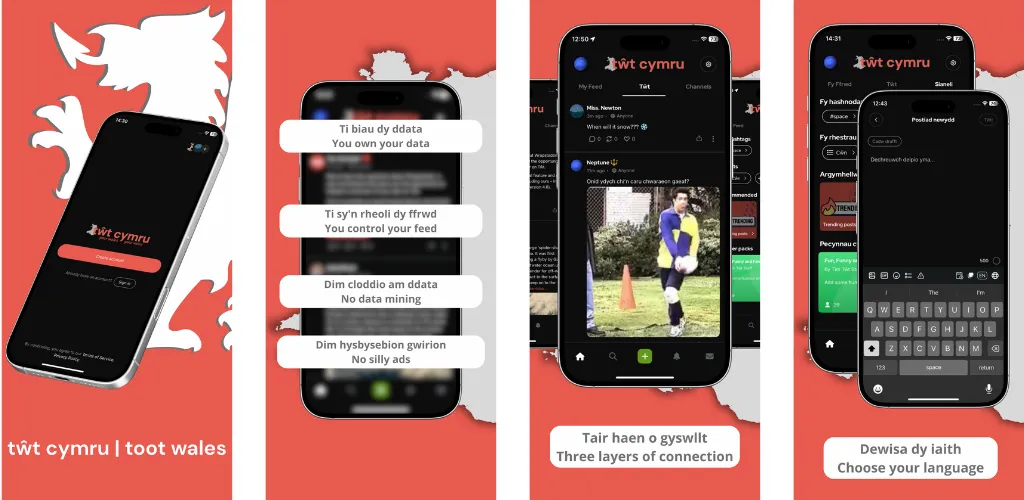
Over the last quarter, we launched two community flavoured apps, with Fediverse communities in Canada - qlub.social - and Wales - toot.wales. The Qlub app is in French-Canadian, with a Spotify style theme, and the Twt.cymru app combines Welsh and English. Both have been carefully curated and tested by the communities, with suggestions and changes flowing back to the app.
For both apps, we’ve installed our Ruby gems alongside Mastodon servers, supporting the unique features on offer inside the apps.
Qlub is our first fully open source project, with all the software installed from our GitHub repositories. Saskia and I were lucky enough to attend FediMTL for the launch of the Qlub app, and its associated channels, in a snowy Montreal in February. A few days later, I was in Cardiff for the launch of the Twt.Cymru app. Jaz has written some thoughtful, caring pieces about what the app means - and Laurens Hof has picked this up in the latest Connected Places newsletter:
Jaz-Michael King has written that “the fediverse is not a place, it is the means to build a place.” His vision is a million small places, each with its own governance and its own front door, connected where it makes sense and disconnected where it doesn’t…King has been building software that takes the instance-level vision seriously. The Twt app for toot.wales is hard-locked to a single instance, with curated local feeds, bilingual onboarding, and a deliberate design that makes the community the unit of experience rather than the protocol. It works precisely because it keeps the experience at the instance level, giving the community tools to define and communicate its identity through software design rather than through social enforcement.
Building on the success of these two pilots, we’re ready to roll out local apps to any Fediverse instance.
Professional networks
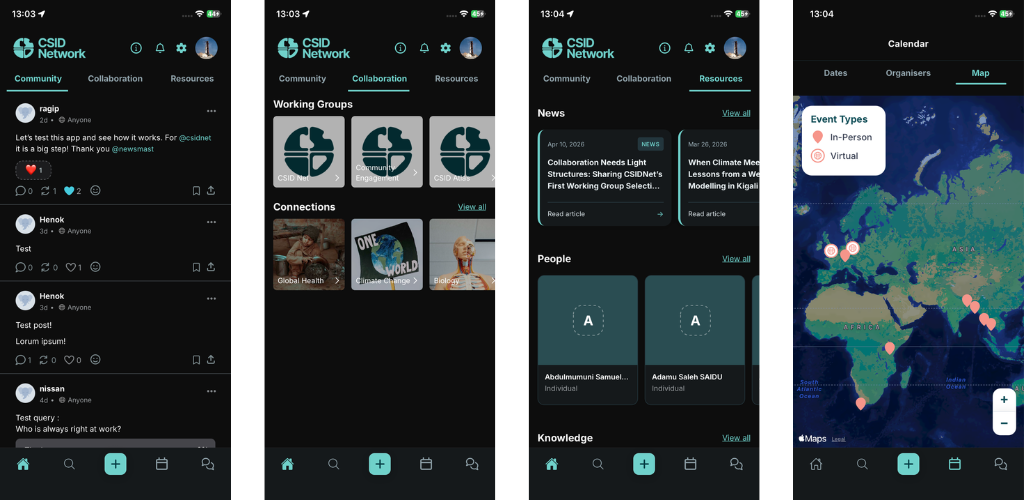
In the pilot phase we’ve been working with two professional networks, and the first of these has just moved into testing. It’s an app for a group of scientists based in Africa and worldwide, working on climate sensitive infectious disease: CSID Network. Following an in-depth workshop and Town Hall meeting with the network, we’ve developed an app and platform tailored to their needs. Some of the innovative features are:
- A community timeline with emoji reactions
- Working Groups and Committees, where permissioned users can chat together.
- A calendar, driven by Lauti’s open source software.
- A member directory, integrated with another open source provider, CiviCRM.
At the request of the network, we’re also testing group conversations and video calls within the app - again using open source solutions.
One of the lead testers of the app, David Makinde, has given us a fantastic review:
What if scientists had their own version of Slack — built specifically for how they collaborate? That’s the idea behind the CSIDNet app.
The platform brings together community discussions, working groups, direct messaging, events, and a shared member directory all connected through CiviCRM. What stands out is the intention behind it not just another platform, but a focused collaboration space tailored to a real community need.
The UX is clean, fast, and intuitive—everything just flows naturally without effort.
The chat and group features are well thought out and actually support real collaboration, not just basic messaging. The research feed, repost, quote, and reaction features all come together to create a smart, engaging ecosystem for sharing ideas and updates.
Honestly, this feels like a platform built with precision and purpose. Exceptional work.
Work in progress
With all this work underway, we’ve a couple of projects which have slipped outside the pilot phase. We’ll complete these in the coming month:
- Totnes Pulse: a hyper-local community combining news and events, running on Bonfire.
- Instituto Brasileiro de Museus (Ibram): a networking app for Brazilian museum professionals.
Build-an-App development
From now until the end of May, we’ll be taking a pause from these highly customised pilots and bringing all we’ve learnt and developed into modular software and applications. The goal is to have a single solution which can be quickly deployed for any flavour of app, and any community. There’s a bunch of strands to this work:
Open source documentation and repositories. We’re moving to a single Newsmast Foundation space on GitHub and working to make this clear and easy to use. The current Newsmast and Patchwork repositories will be archived, as this becomes our live source of code.
Single gem. Our apps currently run on four Ruby gems. We’re combining these into one gem, simplifying the code base, and setting ourselves up to keep pace with major Mastodon versions as they roll out.
Dashboard. We’ll be simplifying the dashboard which runs alongside our Mastodon instances and gem, making it easy for communities to configure things like spam filters, post length and auto-bridging to Bluesky.
Community hosting. We’re reconfiguring our community hosting environment, and will be working with the Mastodon core team to fine tune it further.
Channels. Each community we’re working with has a strong interested in curated channels, both for global discovery and local groups. We’ll be refocusing our channel.org server as a feed generator, serving new communities as they come onboard.
Moderation. Following on from our presentation at Protocols for Publishers, we’ve opened conversations on moderation with ROOST. The goal is to deploy the Coop moderation tool across all our communities.
Build-an-App on desktop. We’re bringing all the client input required to make a community platform and mobile app into one place, where our team and the client can manage flavours, branding and community configuration.
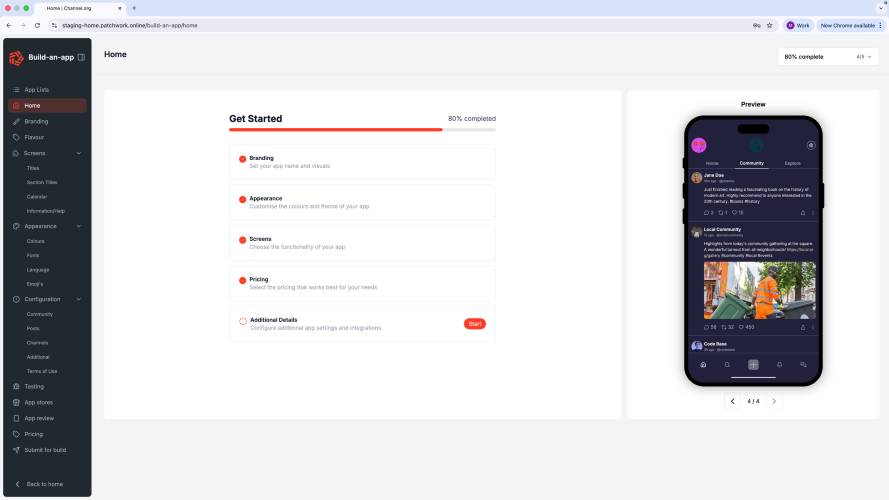
Build-an-App on mobile. We’re combining the four customized flavours of app we’ve developed into one codebase, and one modular mobile app. As part of this process, we’ll be incorporating the best features we’ve developed for different partners.
Build-an-App on web. We’ll create a stripped back web version of our mobile Build-an-App, focusing on the community timeline and channels.
Our team. To help deliver our ambitious goals, we’re delighted to welcome Mariana Borges back to the Newsmast Foundation, as Project Co-ordinator, and to be working with one or our long-standing supporters, Jaz-Michael King, as Commercial Advisor.
Build-an-App rollout
We’ve learnt so much from the communities we’ve worked with over the last quarter, in workshops, co-design and testing. Over the next two months, that knowledge and community-led design work will be embedded into our Build-an-App programme. From June we’ll have a simplified, modular set of code and tools, enabling partner organisations to:
- Create a demo app in hours.
- Share a test app in days.
- Launch a community and mobile app in weeks.
All fully tailored to the needs of the organisation.
As we consolidate our development work over the next couple of months, we’d love to talk to new partners ready to roll out Apps for Change communities over the rest of the year. Book a demo here.